Elon Musk famously claims to sleep and live in his factories to work longer hours and drive his companies forward. This relentless dedication has paid off for him; he is now one of the wealthiest people on the planet. However, the same can’t be said for everyone. Take Nico Murillo, for example. He followed a similar approach, sleeping in his car and showering at the factory, but after four years at Tesla, he was fired.
This disparity highlights a harsh reality: employees, as suppliers of labor, are held to unrealistic expectations. In almost every industry, businesses routinely raise prices in line with inflation without a corresponding increase in product quality. Yet, workers are often expected to improve their output, skillset, and commitment, with only marginal increases in compensation, if any at all.
Some companies go so far as to demand “entrepreneurial employees,” a term that, on closer inspection, is an oxymoron. It’s a way to squeeze effort, creativity, and initiative while offering employees a minuscule share of the resulting profits. The less you profit from your company’s success, the less of your entrepreneurial spirit you should share.
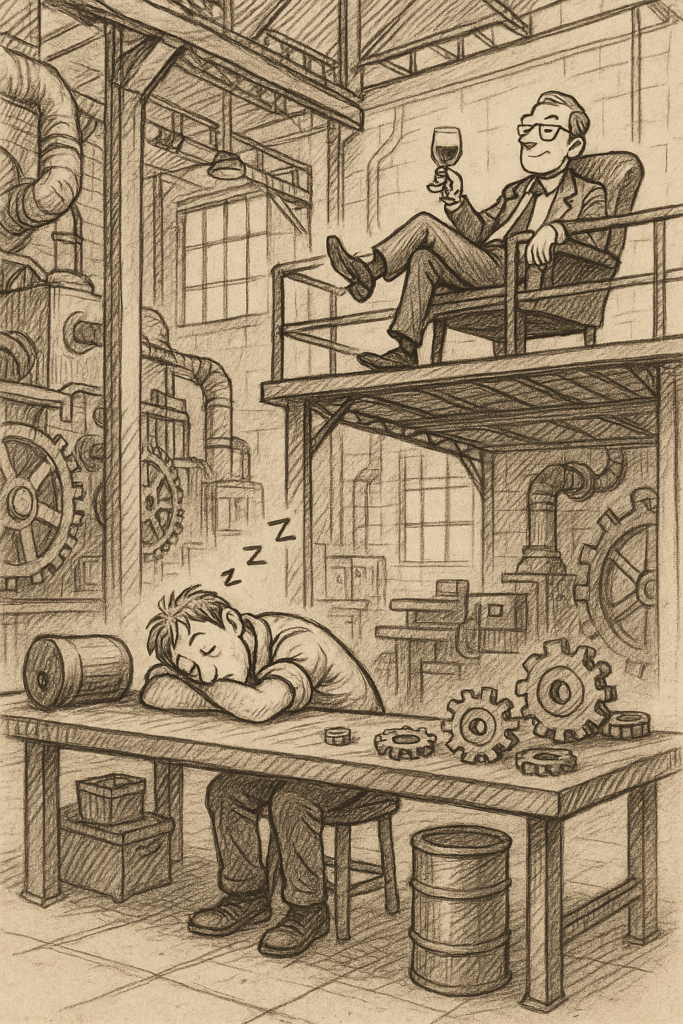
Rational workers don’t slack off because they are lazy. They do it because, in many jobs, extra effort is weakly rewarded. As such, they decide to channel their time and energy into pursuits that provide more utility. This shouldn’t be some radical insight. In fact, I always remember George Carlin’s insightful quote:
“Most people work just hard enough not to get fired and get paid just enough money not to quit.”
In fact, this is described in microeconomics through both individual rationality and incentive compatibility.
Individual Rationality and Incentive Compatibility
This is an economics model that explains how workers are expected to behave due to principal-agent issues and imperfect monitoring, and is taught in the Microeconomics course at Oxford.
- Individual rationality ensures both candidates and employers find value in the job agreement: candidates take the job, and employers hire them.
- Incentive compatibility ensures candidates showcase their real skills and employers are honest about job expectations.
An employer cannot directly observe the level of effort an employee puts in, especially in white collar roles where output is not easily quantified. Think about how many managers push paper and claim the credit for work their underlings do while they’re out playing golf.
Employees would prefer to skive, or do a side hustle that brings in money, rather than work hard to make their employers dream a reality. Overall, the assumption is that employees would prefer to reduce the level of effort if possible. The only thing that prevents them from completely skiving off work on a fixed wage basis is the fear of being discovered and fired.
Employers can however monitor the level of profit they get, which is influenced by the effort put in by the worker – high effort translates to more sales done. As such, the employer can technically choose to profit-share with employees, which comes as a bonus (a % of profits), if effort on the employees part can materially increase the level of profit enjoyed by the employer – even after deducting the employee’s cut. This then poses a very fun economics conundrum – how much would a manager have to pay to ensure best effort by the worker, yet makes sense. In certain cases, employers might find it rational to just hire a worker but not pay them above their reservation wage (the wage they would get outside the job), because the cost of enforcing higher effort is just too high to justify.
In the real world, however, few employees have the ability to directly influence the profit and loss of a company unless it’s a really small company, and hence bonuses are unlikely to drive direct effort. As such, employers instead wield psychology instead of economic theory. Rather than incentivise, they use shaming and cajole employees with “personal development” from taking on more responsibility at work.
“Quiet Quitting”
In 2022–2023, the trend of “quiet quitting” emerged, where employees did only what was expected of them, refusing to go above and beyond. This was met with shock and disdain from many quarters, yet it’s hardly different from how companies behave with their customers.
When I buy 100 grams of minced beef, I don’t expect to find 150 grams in the package. We’re quite content when businesses give us exactly what we pay for—no more, no less. Why should the employee-employer relationship be any different? I find it hilarious, if not a little tragic, that it has become so normalised to be expected to do your best instead of working to expectations.
Of course, the reality is that if you quiet quit while others in your team go the extra mile, they’re likely to be promoted before you, assuming both of you are equally visible to leadership. But therein lies an important point: visibility often matters more than hard work. It’s not about burning out to prove your worth; it’s about maximizing the time spent in positions of influence and recognition.
I’m not advocating that you rest on your laurels, and spend the time away from work sipping on cocktails in the Maldives, simply because that’s not what I would do*. For those of us who are habitual workaholics, push hard if you are confident that the work will be rewarded with higher compensation. If the reward of going above and beyond is simply more work, I’d advise that you put that energy and focus into a second job, or a side-hustle that you’ve always wanted to build.
Give your all for your own life
It’s important to recognize two things: 1) your employer may not always appreciate or reward the extra effort, and 2) your day job is not your only avenue for growth, learning, or even income.
Effort should follow incentives. If your job doesn’t reward extra effort, treat it as a contract, not a calling. Save your best energy both for things you own and to explore pursuits that can lead to true personal and financial growth outside of the confines of your current employer. Your career is just one avenue of growth. In today’s world, diversifying your energy, time, and creativity can be much more rewarding than pouring it all into a single job.
* That said, I must admit that I am very jealous of folks who can really disconnect and enjoy a vacation – it’s something I’m working on as a New Year Resolution.