Have you ever dreamed of staying in an ice hotel, or perhaps sampling exotic delicacies like balut or Casu Marzu? While these experiences might not be on everyone’s bucket list, there’s a fascinating reason why they captivate so many people. Keinan and Kivetz (2011) argue that consumers often approach unique experiences as collectibles, much like how one might collect rare stamps or vintage coins. This mindset drives people to seek out novel and diverse experiences, even those that may not align with their usual preferences or offer immediate pleasure.
This is one of my favourite papers within the Oxford Economics & Management syllabus, because it’s such a refreshing, yet seemingly intuitive idea. It’s also an insight that can be applied in business quite rapidly.
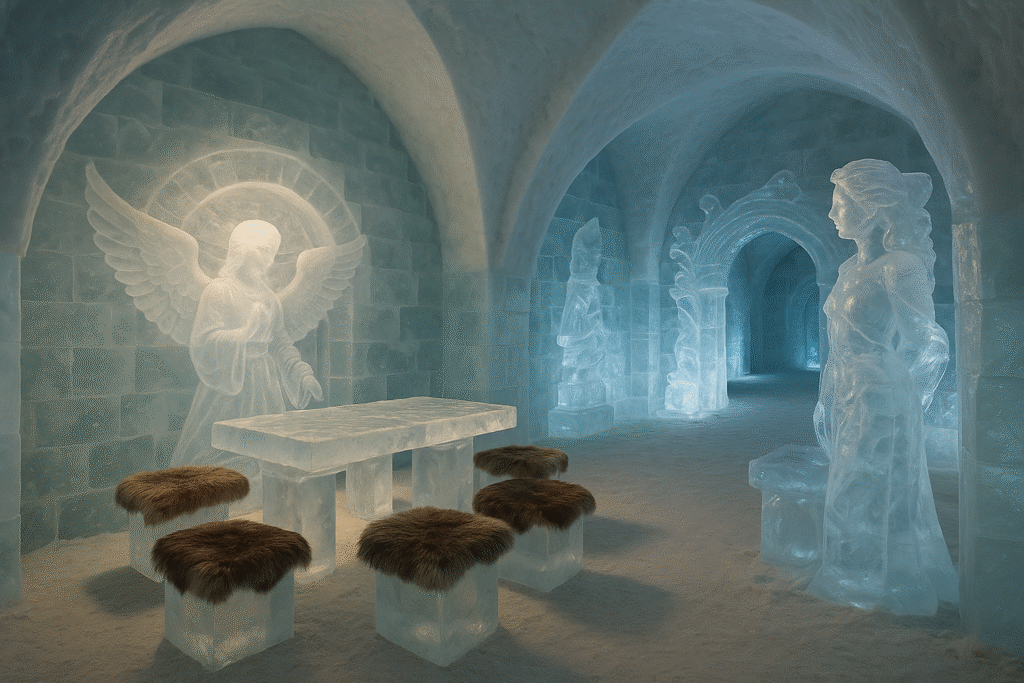
Imagine paying good money to freeze in an ice house over your vacation!
The Collectible-Mindset and Experiential Consumption
Keinan and Kivetz’s research reveals that for many consumers, the value of an experience isn’t solely derived from the pleasure it brings, but also from its uniqueness and rarity. This mindset leads to what the authors describe as “experiential CV-building,” where individuals accumulate a diverse portfolio of experiences. The drive to collect these experiences can sometimes override personal preferences, leading people to prioritise visiting a wide range of destinations or engaging in unusual activities, even if they aren’t particularly enjoyable.
For example, someone might choose to stay in an ice hotel, not because they enjoy the cold, but because it’s an exotic experience that they can add to their collection. However, the desire to repeat such an experience often diminishes after the first time, as its novelty and thus its collectible value wanes.
The Role of Productivity Orientation
One of the most intriguing findings in Keinan and Kivetz’s study is the role of productivity orientation in driving this behaviour. Individuals who are highly productivity-oriented aim to maximise the use of their time for something useful. This productivity-driven approach turns the pursuit of experiences into a form of achievement and makes people more susceptible to this collecting mentality.
Extension: The Impact of Social Media Amplification
Beyond the original findings by Keinan and Kivetz, social media has amplified the drive to collect experiences. Platforms like Instagram have transformed the way we share our lives, allowing us to broadcast our experiences to a global audience. The act of sharing unique experiences on social media not only satisfies personal desires for recognition and validation but also feeds into the collectible mindset. The more “collectible” an experience appears, the more social capital it accrues when shared online.
This phenomenon means that experiences are no longer just personal milestones; they have become social currency. Productivity oriented people may treat social posting as part of “using their time” efficiently. The desire to showcase one’s experiential CV online can intensify the pursuit of collecting experiences, sometimes at the expense of their genuine preferences.
Implications for Marketers: Embracing the Experience Economy
I see this phenomenon reflected in my social circle. It’s the highly driven Type-A individuals who seek out unique experiences, while my other friends choose to head to a beach in Greece or Spain. It’s such a powerful insight that can help in marketing. For instance, advertising a resort-style stay by creating something special for the high-productivity individuals to “collect”.
For marketers, understanding the collectible-mindset and the role of productivity orientation in consumer behaviour offers valuable insights into how to create and promote experiences that resonate with today’s consumers. The experience economy, where products are marketed as part of a broader, immersive experience, is increasingly important.
Restaurants, for example, are no longer just places to eat; they are now venues for curated experiences that people can share and celebrate. From themed decor to interactive dining events, these establishments are designed to offer something unique that patrons can add to their experiential CVs and, of course, post about on social media.
Similarly, travel and leisure companies are capitalising on this trend by offering packages that emphasise once-in-a-lifetime experiences, from staying in underwater hotels to participating in authentic cultural rituals. The key is to craft offerings that are not just enjoyable but also rare, memorable, and shareable.
As a marketer, the implications are to move towards the experience economy – to not just sell products but also to make it an experience. That is why so many restaurants are sprucing up their locations – not merely to boost the ambience but also to be featured as part of a collectible experience.
Reference
Anat Keinan, Ran Kivetz, Productivity Orientation and the Consumption of Collectable Experiences, Journal of Consumer Research, Volume 37, Issue 6, 1 April 2011, Pages 935–950