Behavioural economics is a fascinating field that bridges psychology and economics, offering insights into how people actually make decisions, often in ways that deviate from traditional economic models. In this article, I walk through some of the main branches of behavioural economics that are covered by the economics department at Oxford: nudges and inertia, as well as the risks in leaning on these techniques.
Nudges
A nudge is a subtle change in the environment that alters people’s behaviour in a predictable way without forbidding any options or significantly changing their economic incentives. It works by changing the choice architecture, meaning the way options are designed and presented, so that the setup gently steers what people choose while keeping their freedom to choose.
For instance, putting fruits and vegetables in more salient locations than candy bars in Tesco’s would be a nudge to get people to eat healthier. People can still easily access candy, yet a significant population has been shown to instead switch to fruit, because choosing fruit reduces the mental load.
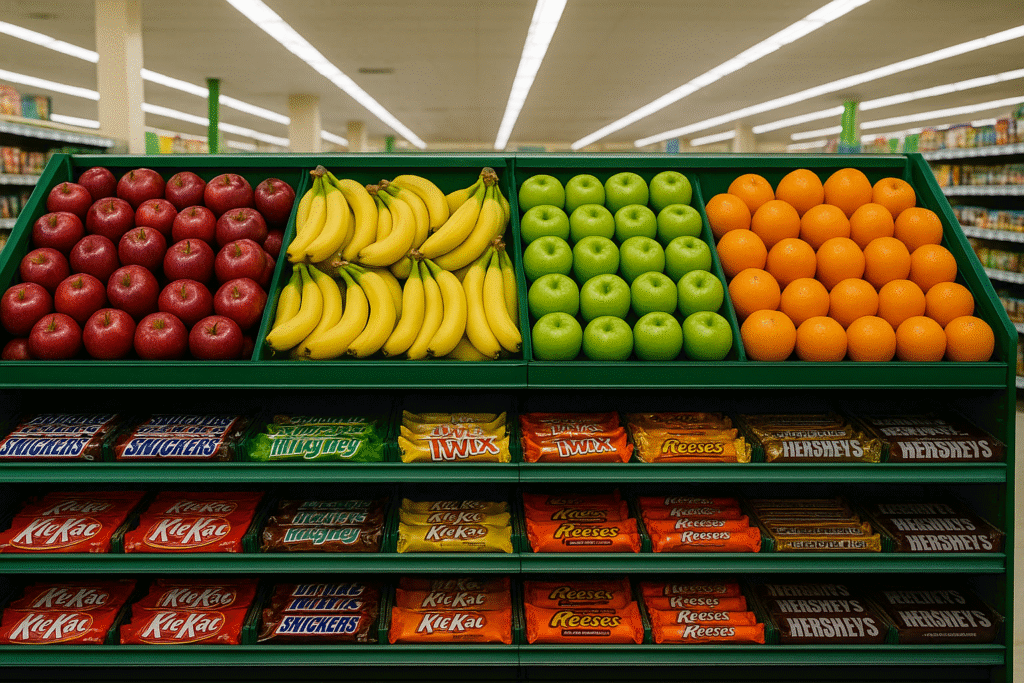
Advertising might be considered a nudge, as it also serves to make a product more salient, insofar as the advertisements do not reveal new knowledge to customers.
Self-nudging is an extension of this concept, in which individuals set up their own choice architecture to promote desired behaviours:
Setting screen time limits on devices to reduce social media use.
Placing gym clothes next to the bed to encourage morning workouts.
Inertia and status quo bias
People are just inherently inert. I feel it every morning when I struggle to get out of bed. The energy used to deviate from the status quo is something that we actively seek to avoid. There are ways to leverage this. One method is using apps that automatically round up purchases to the nearest dollar and invest the difference. This gets over the inertia to compel people to invest.
While this can be a powerful tool for social good, there are ethical dilemmas to leaning on inertia as a tool. Organ donation using an opt-out method has helped to raise sign-up rates. There is no benefit to opting in. Some people have strong opinions and will actively opt in or out. As such, to ensure bodily autonomy is respected, people must find it easy to opt out or opt in. However, since people are so accustomed to the status quo, those who do not mind either way will follow the default option. Given the vast societal benefits associated with more organ donation, this is a wonderful use of behavioural economics. However, Thaler and Sunstein have argued against an opt-out system, because some family members have challenged the decision based on whether the case is truly opt-out. One potential solution I can think of is to have a default opt-out, but also give a separate checkbox for people to indicate that they want to reaffirm their opt-in status.
Profit-seeking
Behavioural economics can be vastly helpful to marketers. Studies have revealed that giving coupons early in the decision-making process more effectively raises total spend as compared to later in the purchasing decision.
However, this could be seen as manipulative and result in reputational damage. Behavioural economic applications are probably less acceptable if they seek to leverage informational and environmental control of the seller to implement a zero-sum transfer of consumer welfare to the producer. Some services that try to make it more inconvenient to cancel their services have lost my respect, and I will go out of my way to warn my friends. This is especially so for subscription services that purport to offer a free trial but make it difficult to cancel and hence potentially trip you up with a fee once the free trial is over.
Richard Thaler writes about “Sludge”, dark patterns and bad nudges towards the enrichment of the nudger at the expense of the nudged. You might have seen some sludgy business models; one particularly hated example being drip pricing when you get charged multiple fees that are unavoidable. Thankfully, the Competition and Markets Authority is now looking to ban this sludge.
Studying the Behavioural Economics module at Oxford
This would entail submitting an essay based on a research question you come up with. You will have to conduct an experiment with another of your peers. I find this particularly fitting because most of these are observed empirically. It is a rather fascinating look into economic research design, outside of a thesis.
Although you will probably spend more time on this as compared to studying for an exam, taking this module would help to decompress your workload come Finals season, since you can work on this before. It can be frustrating to execute your experiment, especially if you have to beg, plead and coerce your friends to be participants. That said, I think it is a fantastically unique experience to add to your Oxford life if you are up for a challenge.