Disclaimer
This article is for general educational and informational purposes only. It reflects the author’s personal views and should not be treated as investment, financial, legal, tax, or other professional advice. Investing involves risk, including the possible loss of your entire investment. Past performance is not a reliable indicator of future results, and examples mentioned in this article are not recommendations to buy, sell, or hold any security, fund, asset, or financial product. You should do your own research and consider seeking advice from a qualified financial adviser before making any investment decision.
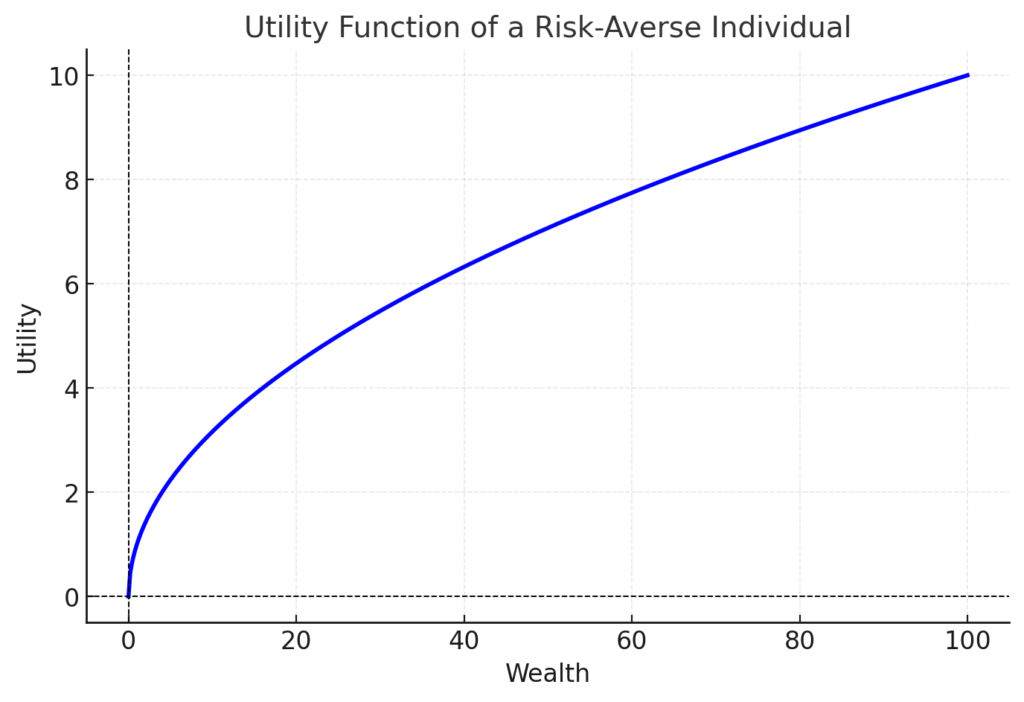
Humans are inherently risk-averse. This means that, when presented with a choice, most people tend to prefer a certain, lower reward over a higher potential reward that comes with greater risk.
The St Petersburg Principle involves a hypothetical game where a fair coin is flipped until it lands heads. The payout for the game doubles with each toss, starting at $2 for one toss, $4 for two tosses, $8 for three, and so on. Would you pay $100 to play this game? On paper, the expected value of this game is infinite:
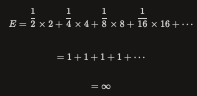
Yet most people would hesitate to pay even $20. Why? Because infinite expected value clashes with diminishing marginal utility: as the payout grows, the additional value of money becomes less meaningful to individuals, so the negative aversion towards risk outweighs the additional benefit of payout.
It’s for good reason too. There is realistically very little difference between having $1 trillion dollars and $2 trillion dollars in today’s economy, since you can’t finish consuming $1 trillion in your lifetime. However, being bankrupt and a billionaire is a world of difference, even though the difference is a thousandth of the difference between 1 and 2 trillion.
Insurance vs gambling
Diminishing marginal utility means that it is possible that fully rational individuals buy insurance willingly while insurance companies continue to rake in profits. Insurance provides certainty and protection against potential financial losses, aligning with risk-averse behaviour. For risk-averse individuals, the utility derived from a guaranteed, smaller loss (the insurance premium) is greater than the disutility of a potentially large, uncertain loss, even if the expected wealth without insurance is mathematically higher.
Insurance also helps to unlock the capacity to take additional risk, when the situation has a positive expected return. For instance, a person might feel more empowered to pay for university (which is likely to return more in future earnings), if they have insurance to cover the downside risk of falling ill. Without insurance, it might be a dangerous gamble to go to university, fall ill with a debilitating disease and end up struggling financially.
Despite this aversion, people frequently engage in gambling where the expected value is less than 1. Funnily enough, it seems like people do pay to undertake risk.
Take a common casino game like roulette. In American roulette, the wheel has 38 slots—18 red, 18 black, and 2 green (0 and 00). Because the house has built in 2 greens to better their own odds, you only have a 47.4% chance of winning. So for every dollar you bet, you can expect to lose 5.3 cents in the long run. The house collects the expected value, and all the gambler receives is the volatility of uncertainty rather than hedging against risk.
Yet, gambling persists, not because it’s a sound financial decision, but because of the emotional payoff.
The utility of gambling vs. risky investments
Of course, gambling has its merits; people aren’t just throwing their money away. Instead, they are consuming a service that provides entertainment and excitement, a way of buying the hope of striking it big with a jackpot.
It’s almost like paying through the nose for bungee jumping in the pursuit of adrenaline. However, I’d argue that if the thrill is the primary goal, you might consider risky investments on well-regulated exchanges instead. This could be a more productive outlet to fill the desire for risk-taking, especially since these investments often offer a positive expected value.
Unlike gambling, where the house always has an edge, the expected value of a stock is often positive, if they are traded on a well-regulated stock exchange. Yes, the stock market has its risks, but a company’s performance isn’t predicated on rigged odds. After all, management is striving for growth, in fact they have a fiduciary duty to create value for shareholders. Instead of wagering against mathematically stacked odds, you are riding on an aligned incentive to make money across shareholders and managers.
For example, small-cap stocks, which are stocks of companies with a relatively small market capitalisation, often carry more volatility but also more room for growth. The small-cap premium (Banz, 1981) came from the realisation that smaller companies tended to generate higher average returns than larger ones. This could be seen as compensation for the higher risk faced by investors in these stocks.
Risk management: treat risky investing like gambling
That said, risky investments should still be approached with the same caution as gambling. Just as you wouldn’t walk into a casino and place your life savings on red, you shouldn’t allocate a significant portion of your portfolio to speculative stocks. Instead, it would be wise to allocate only a small fraction of your wealth —an amount you can comfortably lose to these types of investments. Consider it “play money,” akin to a gambling budget.
As a counter-point, you do have to watch out for brokers who push their pet holdings, or are seeking to offload their shares on unsuspecting retail investors. As such, I often avoid penny stocks, and instead put my entertainment money towards highly volatile industries like biotechnology or hydrogen generation instead of focusing on singular stocks.
By taking this approach, you can still enjoy the thrill of uncertainty and the potential for large gains, but with the added benefit of a positive expected value. In contrast to gambling, where the expected outcome is a guaranteed long-term loss, the stock market allows for the possibility of a win-win: even if your risky investment doesn’t pay off, your losses are limited, but the potential for gains is real.
Ultimately, whether through gambling or investing, risk-seeking behaviour is a part of human nature. The key is to channel that behaviour into avenues where the odds are more in your favour, where risk has the potential to lead to reward, rather than just entertainment.