When I started my graduate role in corporate strategy at a large company, I had to take on numerous cost-cutting projects. What I learnt is that cost cutting is often underrated in difficulty and often misused. This is also why the Sandcone Model sets cost as the last priority in building competitiveness.
The Sandcone Model (Ferdows & De Meyer, 1990) posits that operational excellence in manufacturing builds cumulatively: first by ensuring quality, then reliability, followed by speed, and only then focusing on cost. Skipping or reversing this order risks undermining long-term competitiveness. It points to the trade-offs between the criteria for evaluating operations (cost, quality, dependability, speed, and flexibility), but argue that the criteria should be built in a specified order:
- Quality
- Dependability
- Speed
- Flexibility
- Cost
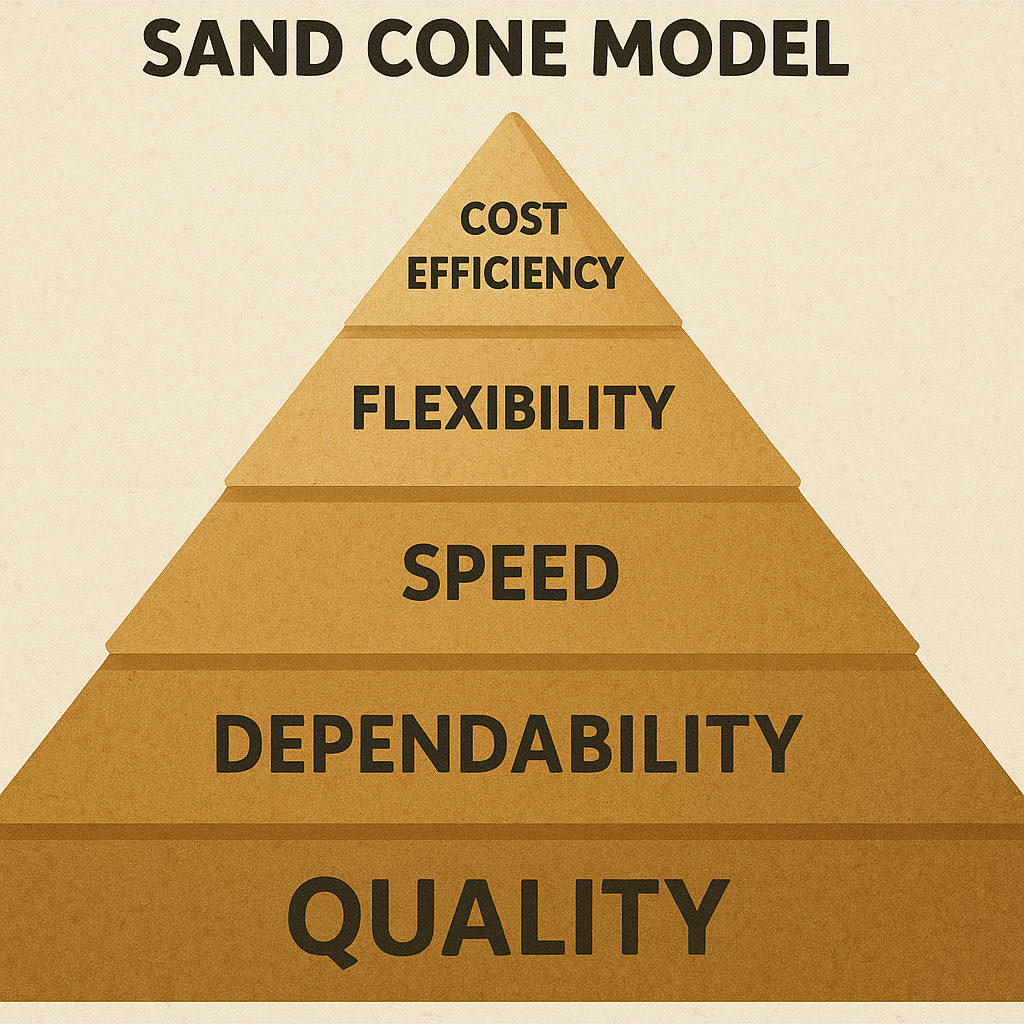
Ferdows & De Meyer argue that building the next capability too quickly before the previous one risks the entire sandcone collapsing. Cost is the last optimisation, because securing the initial three will help a company stand out and incremental reduction to superfluous costs can be effective.
Application of the Sandcone model
Cost-cutting is hence often ineffective when prior capabilities are not established. Some managers see cost-cutting as a way to force operational discipline. Top-down budget targets can be helpful when used as a spur to prompt employees to pay more attention to cost-controls. Managers unfortunately often reach for the budget reduction lever indiscriminately though, because the results can be rapidly observed as expense line items are eliminated.
It’s far too easy for a central bureaucrat to say: “costs are too high, we need to trim it”. However, it is tough to parse out which departments are overspending, and which are being responsible stewards of the company budget. As such, tradeoffs in product quality often have to be taken, rather than a simple reduction of costs being a Pareto-optimal solution.
These compromises on quality, dependability, and other intangible measures are often less obvious, yet pose an insidious risk to the future prospects of the company. In addition, some corporate leaders suggest cuts in budgets across the board. This is harmful, because it hurts the responsible spenders who did all they could to trim the fat from company operations and are running on low. This also incentivises departments to spend more in order to justify a higher budget, in case they have to make future cost-cuts.
Effective budget cuts should come with an identification of how value can continue to be provided under the alternative. The implementation of self-service technologies is one, as long as consumers find that it adds value to their lives. For instance, airlines moved their flight booking operations from travel agents to booking online. This meant cost-savings for the airlines, while also providing a better quality of service and speed to consumers.
Real life inspiration and warnings
IKEA is a company that has managed to navigate working on lean budgets while thriving. One deliberate policy is to set the price of the product and then design the product, instead of the other way around. However, this works because IKEA has set a name for itself by producing affordable furniture for the masses, and then leaned into its economies of scale as a defensive moat. Furthermore, many of their cost-saving initiatives were innovations that improved the customer experience – flat-packing for instance not only lowered IKEA’s transportation and inventory costs, but also made it easier for the customer to bring home. Other cost-control measures, such as entertaining guests in IKEA cafeteria’s, not only saved costs without compromising on core product quality, but also incentivised better quality of food.
In contrast, Sears supermarket went bankrupt despite, and perhaps because of, aggressive cost-cutting. It moved towards cheaper and lower-quality products in a bid to cost-compete against Amazon, which alienated its customer base. Furthermore, investment in store maintenance was lowered and the customer experience suffered. Without a sufficient strong base in quality of service or dependability, the turnaround attempt by cost-cutting ended in a declining spiral as customers shunned the stores.
For an example from public policy, the New World screwworm has returned to Texas. These flesh-eating flies that devastate livestock were eradicated from the USA for 25 years. Quite ingeniously, male flies were sterilised with radiation and released to end the flies’ bloodlines. This is often attributed at least in part of budget and monitoring cuts from the USDA. As funding feel for the screwworm eradication program, the Screwworm managed to make a comeback into Texas. If they are allowed to expand their presence, it will either cost the Texas statement economy a projected $1.8 billion annually due to livestock losses and medication, or an expensive campaign to eradicate them again. The Central America program in the past is estimated at $200 million. Meanwhile, the total cut under the Global Health Security Program was $250 million, where screwworm containment was just part of the budget. Cutting costs now could thus result in far higher costs down the road, because the threat had not been fully eradicated before the budget to contain that threat were cut.
It’s very easy to put the torch to line items on an income statement. You just have to remove the cost, cancel contracts and your spending shrinks. Unfortunately, without a baseline of strong performance, cutbacks applied on spending with a positive ROI can end up negative.
The economic slowdown as a result of the Russian invasion of Ukraine and higher interest rates has rightfully put more focus on profitability rather than revenue growth. Still, I would always caution against celebrating managers who come swinging into an organisation promising to cut the fat. It’s not easy to see when vital muscle and flesh being removed that will result in a gradual but inevitable decline later. Instead of indiscriminate cuts, companies should evaluate cost-saving opportunities through the lens of long-term operational priorities, as outlined by the Sandcone Model. This ensures cost-efficiency without sacrificing the pillars of quality and customer trust.