As a kid, I had always believed that the London streets are paved with gold, as was mentioned in the story of Dick Whittington and his cat.

It’s one of the largest financial capitals of the world. A city with rich history and once a centre of power that controlled colonies across the world. I desired to study in the United Kingdom, in part to migrate to this wondrous place in search of a better future and contribute to it. These were my naive considerations when choosing a university. Once I received my Oxford offer, it appeared to be an obvious choice to take the plunge.
Having gone through the full degree and now working, I hope to help prospective international students make an informed choice on taking the plunge. I will take this as a dichotomy between studying locally and studying abroad. This perspective will pertain more to Oxford, but many points will be the same for any other university in the UK.
Visas and the right to work
As a worker, it can be hard to get a company to sponsor a work visa in London, especially if you are early in your career. But as a student, you can usually move onto a graduate visa after your degree, which gives you a few years to stay in the UK and try to build a career. It does not guarantee long‑term sponsorship, but it makes the first step into the UK job market much easier
Education cost
As an international student, you do not have the cover of government subsidy, which studying within your home country would likely avail you to. It can be incredibly expensive, going up to about £28K per year. I have to warn that the high cost of tuition does not necessarily reflect a proportionately high quality of experience. Since the government imposes a cap on tuition for local students, the fees for international students is set artificially high as a way to subsidise the education of local students. While every government must look out for the rights of its citizens first, do realise that the cost of your Oxford education, as a minority group of international students, will partially be spent on enhancing the educational experience of the majority of local students.
Perspective and Culture
This is based purely off my own anecdotal experience but it’s been eye-opening coming to Oxford, for sure. Being surrounded by people who have so much passion, love, and deep expertise around their fields is an inspiring experience. The UK also has a rich history and an entertaining political scene.
London is a wonderfully dynamic place. The rich culture and arts scene means musicals and shows are just a stone’s throw away. Some of the most picturesque parks combined with beautiful historical architecture preserved through zoning laws make for a beautiful stroll that lifts my spirits.
Being able to study and work in this country has frankly been an immense joy in this aspect and I am convinced that my quality of life supersedes what I would have in my home country. I would recommend spending some time in the UK on holiday so that you get a feel for yourself whether this is an environment you will enjoy. There are definitely downsides to London, such as the weather (which we spend a lot of small-talk complaining about!).
Entrepreneurship prospects
The entrepreneurship scene in UK, and the rest of Europe, is not as vibrant as it could be. This is not for lack of founders, given the depth of technical knowledge in the population – indeed, the numbers of DPhils I have chatted with at Oxford is testament to the potential of the startup ecosystem.
The demands of university for royalties and ownership stake in the UK is immensely onerous. Today, spinouts give the University of Oxford 20% of their equity. This was a recent change in September 2021, from a previous system that saw the university take 50% of equity. Meanwhile, Colombia University takes 5% equity, while Stanford asks for the right to purchase up to 10%. This can can put off some potential founders who worry about dilution.
Founders in the US are also boosted by access to easier venture capital. While OpenAI took the world by storm and was a major boost to Silicon Valley’s reputation as the place to be for startups, few realise that the original AI startup, DeepMind, had its origins at University College London. Yet, the company moved to the USA for easier access to funding.
In addition, complex legal and regulatory processes in parts of Europe can slow down deal‑making and make it harder to move fast, stymieing efforts to create a Silicon Valley equivalent. As an egregious example, Germany has a law that mandates that a notary has to be hired to read out the entire contract. It makes even simple agreements slow and hard to follow, especially when large sums of money are involved.
If you are set on building a startup, the UK can still be a good place to learn and meet co‑founders, but you should be realistic about the ecosystem and consider whether you might eventually move elsewhere for funding.
Working in corporate
For salaried workers, the UK generally lags behind the USA in salary. The median weekly wage in the US is about £740, while it is £586 in the UK.
Average hours worked in the UK and the US are fairly similar, so lower weekly wages usually translate to lower hourly pay too. That said, when you consider what you can buy with that salary, the gap between the UK and USA shrinks by virtue of the higher cost-of-living in the USA.
I used the USA because it’s a convenient benchmark. That said, you will have to compare the UK against the countries you will likely work in if you do not study in the UK. If your home country has much lower wages than the UK, this difference might still work in your favour. If your home country already pays well, the UK may not be a clear upgrade.
Taxes and social support
Income taxes in the UK are often quite high and can be a huge shock when first assessing the post-tax wage of your graduate role.
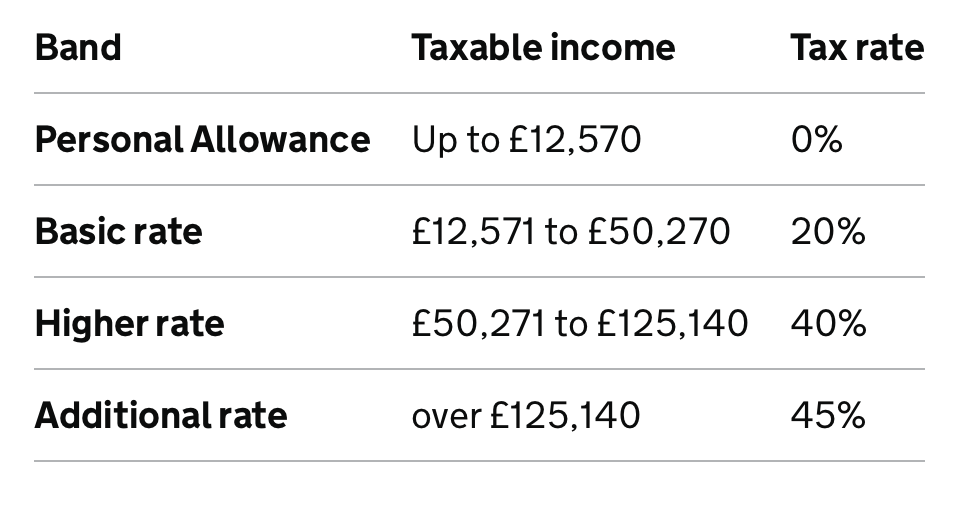
Source: https://www.gov.uk/income-tax-rates
Note that on salaries above £100,000, every marginal £2 you earn results in a reduction of your personal allowance by £1. This means that if you earn for every £2 you earn, you are being taxed 40% on £3 of income, until the personal allowance is fully depleted at £125,140.
Healthcare is free in the UK, compared to countries like the USA where the uninsured probably lack proper medical coverage. However, I think the NHS faces a difficult moral hazard problem. When healthcare is free, people have no limit to consume these services, even if the societal marginal rate of return has diminished to a tiny degree. In my own social circle of international graduates in London, many end up using private healthcare for speed and convenience. That may or may not be necessary in your case, depending on your health and how patient you can be with waits.
Consider your option set
With this, you should develop a list of schools that you would go overseas for. Personally, I restricted my choice-set to only Oxbridge. I do encourage you to base your choice off your individual financial situation and projected return on education investment – many of my friends from home went to schools like LSE and UCL, and similarly found it a great experience.
As a rough guide, think about three things: what you can afford, how strong the degree’s brand is back home (as a fallback option in case you want to return), and how much you value the chance to live and work in the UK compared to staying where you are.